located on ancient trading path

The Waxhaw and Catawba Indians called this area home well before our ancestors. These indigenous people farmed the fertile land and hunted the woods, which were abundant with deer, turkey and other wildlife.
here from Pennsylvania

Our Scoth-Irish forefathers called this area their home beginning in the 1760's. After living in Carrickfergus, county Antrim, North Ireland for a generation, these people sought out a better life in the New World.
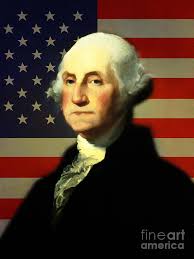
Near what is now Rock Hill Highway (Hwy 9) and Charlotte Highway (Hwy 521), is the site of Major Robert Crawford's home where President George Washington spent his last night in South Carolina during his Southern tour on May 27, 1791. During his stay, Washington was met by Catawba Nation chiefs who expressed concerns about potential attempts to seize their land.

The Seaboard Railroad established a station at Van Wyck in 1887. A depot built on land given by the Heath family consisted of two waiting teams, a freight warehouse, and a loading platform.
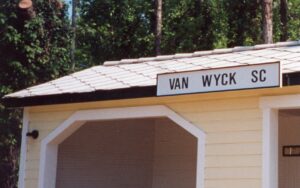
When the Seaboard Railroad was built in 1887, the railroad stations along the line were proposed to have Indian names to honor the previous inhabitants. Although the area had been long known as Little Waxhaw, the name was already taken by the Waxhaw station to the north, and another name proposed to honor the family that provided the land for the train station, Heaths, was also rejected due to a station to the south already named Heath Springs. The name was finally chosen by the station master to honor his wife, and so was given the name Van Wyck after her family who originated from New York.

As recorded by the National Archives and Record Service, Washington, D.C., the Van Wyck Post Office was established on June 25. 1889. The post office was located in various stores on the Main Street of Van Wyck until 1974, then was moved to new quarters next to Jingle Jungle store.
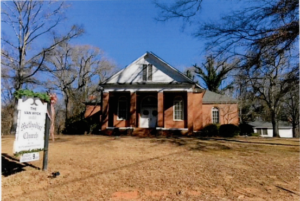
The Van Wyck United Methodist Church, originally know as "The Little Waxhaw Methodist Church", was originally located on the property of the present Van Wyck Methodist Cemetary. In 1890, when the Seaboard Airline Railroad changed the name of the train station to Van Wyck, the church officials met and decided to change the location and purchased 2 acres to build the new church. In 1920, the church building was remodeled and enlarged by the addition of two wings for Sunday School rooms.

Ashe Brick Company was founded before the turn of the century. Mr. William Newton Ashe began making brick by hand from clay mixed in a mule-drawn mixer in his father's pasture in McConnelsviille. Later his brick business was moved to Greer and in 1903 to Rock Hill. In 1906 it was located in Van Wyck near the pits that furnished clay for the plant.
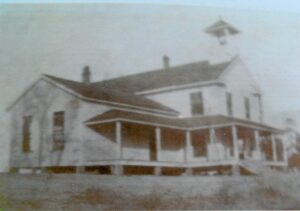
This school was build in 1911 and was in use until it was replaced in 1924. Later it was moved closer to the road and transformed into a family home. It is located at 5090 Old Hickory Road.
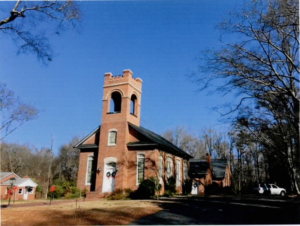
The Van Wyck Presbyterian church, originally known as Beulah Presbyterian Church was built on a lot donated by C. S. and R. H. Massey. In 1940 and 1941 the Educational Building was erected. The manse was built in 1951.
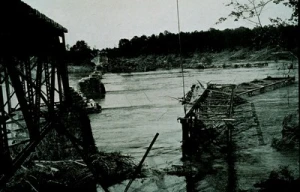
Almost three-quarters of a century before Hurricane Hugo, the “Great Flood of 1916” devastated the Catawba River Basin. History-making floodwaters came barreling down from the North Carolina mountains toward Lancaster County when two category-4 hurricanes converged over a period of six days in mid-July. The record-breaking rainfall saw the Catawba River cresting at 47 feet and Van Wyck was underwater in places where water had never been before. The resulting flood waters affected thousands of people from Asheville to Fort Mill, South Carolina as it washed away homes, bridges and businesses and killed 80 people.
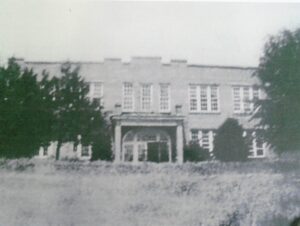
The second school named Van Wyck, a large brick building with wood and plaster walls, was completed in 1924. Wings were added on either side in 1935. This building was closed in 1952 and the students were transferred to Indian Land or Lancaster schools.
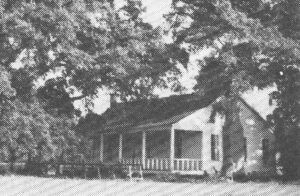
An organizational meeting was held on Sept 16, 1927, for the Van Wyck Country Club. The clubhouse on 16 1/2 acres of land was deeded to trustees Everette P. Nisbet, W. N. Ashe, C. R. Yoder, S. L. Thompson, W. H. Moore and their successors by Dr. James D. Nisbet in 1927.

The Ashe Ferry was built in 1927 and 1928 by the Ashe Brick Company. Roads were constructed by company help using mules and drag pans. Ashe's Ferry was taken over by the state in 1941 and closed in 1959 when the Bradford-Ashe bridge was built.
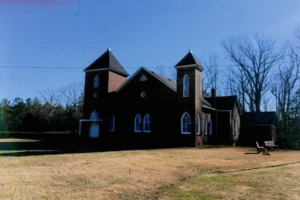
White Oak A.M.E. Zion Church was so named because it began in a white oak grove in Springdale Community over a hundred years ago. The church has been in two locations and has been at the present site since about 1928.

The Van Wyck Community Development Club was organized in November 1954 and on September 6, 1957, purchased the old Van Wyck school building which was torn down in 1960-61 and replaced by the modern building shown here. Van Wyck residents celebrated the completion of their new Community Center on February 11, 1963, with an "Open House" and a tour of the facilities.
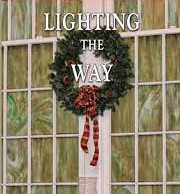
In 1993 Van Wyck began a new tradition. The Christmas season is observed by a "lighting of the way". Thousands of candles in hurricane lamps glimmer throughout the community. Neighbors gather to light candles and enjoy the Chrismas programs prepared by the Van Wyck Presbyterian church, the Van Wyck Methodist Church, Trinity Presbyterian church, the AME Zion United Methodist church. The final stop is at the Van Wyck Community Center for refreshments, singing and fellowship.

Van Wyck was incorporated as an official Town in 2017 and thrives as a close-knit, rural community that values sustainable growth and civic engagement.